Bible study notes

The 'Ebed Laws

A side-by-side reading of study notes on Exodus 21, the Book of the Covenant, and laws oriented toward protection, rest, restoration, and freedom.

Download Exodus 21 PDF

Bible Study

The 'Ebed Laws

  • A Bible study on one set of "offensive" passages from the Bible
    • Pattern of resolution of offense over time provides warrant for not jettisoning faith because there are objections
    • We do not have to pretend like there are no objections. The Bible is full of examples of saints wrestling with God.
    • Assume a position of epistemic and intellectual humility.
    • Found Dr. Carmen Imes's class on Exodus 21 from The Bible Project helpful
  • Exodus 21 - The 'ebed laws
    • Goal of the laws is to protect the vulnerable and prevent exploitation
    • Designed to prevent abject poverty
    • The laws orient one towards God's Sabbath rest - they consistently push towards freedom and away from slavery and bondage
    • The laws sow the seeds that make slavery untenable
    • Exodus 20:23 till chapter 23 are known as the Book of the Covenant or a Law Code. These are casuistic laws as opposed to apodictic laws.
  • Read 21:2-6 - the case of the male 'Ebed
    • Voluntary hired worker (not "man stealing")
    • Limited term of service (not "forever")
    • Free to leave and marry
    • Permanent service is voluntary
    • The wife of the servant cannot leave because her debt doesn't get cancelled just because she got married (she is an 'Ebed herself)
  • Read 21:7-11 - the case of the female 'Amah
    • English translations use the same word "slave" - but the Hebrew doesn't
    • The 'amah marries into the household (the master or his son)
    • Marriages always involved money in the ANE (both a dowry and a bride price)
    • Marriages were always arranged (a lot like India)
    • A man in financial distress might arrange a marriage for her daughter with man or his son who is able to pay the bride price
    • Because this is marriage there is no expectation that the woman will leave after 6 years
    • Designed to guard against sexual exploitation
  • Why couldn't God just abolish slavery?
    • Fallenness demands regulating an existing system rather than upheaval ("it is because of your hardness of heart that Moses allowed you to divorce your wives, but from the beginning it was not so").
    • The arc of salvation is long but sure.
    • God is not pro-polygamy but widowhood means penury to prevent which God introduce the law that requires the brother of the deceased husband to provide chlidren for her. But what if the brother is already married? Then he must take on a second wife. God is not pro-polygamy but He allows a temporary measure in order to care for the weak and vulnerable.
    • Institution of God's absolute ideal would also mean the end of the age and judgement.
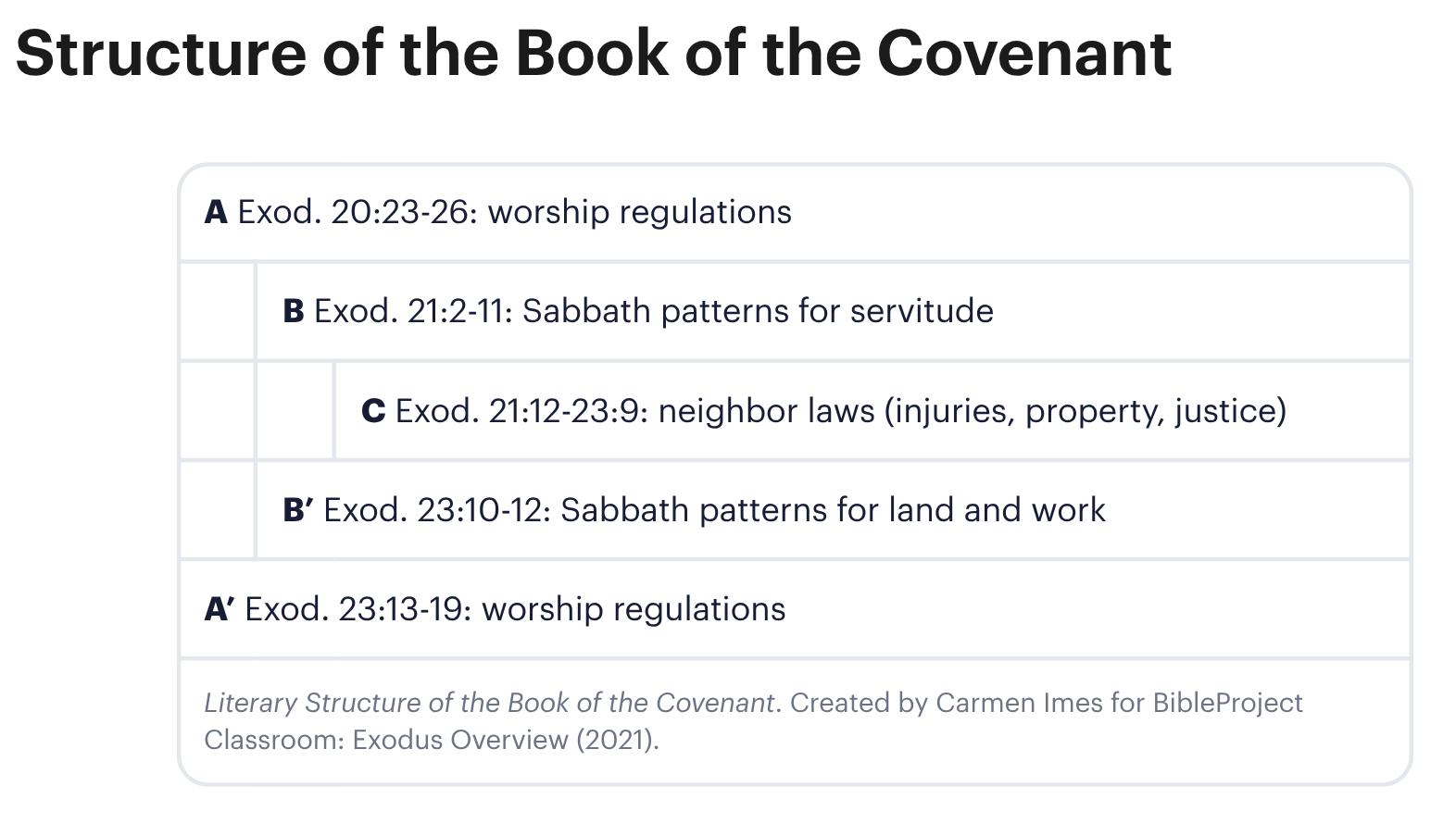
  • Chiasm of the Book of the Covenant
    • The laws appear in the "sabbath" portion of the chiasm
    • They are oriented towards liberation from bondage. The focus is on setting people free and preventing exploitation and protecting the vulnerable.
    • The theme is freedom and restoration and not accumulation of power or oppression
    • Similar slavery related laws appearing in Deuteronomy and Leviticus also appear in the context of the Sabbath. Whenever God talks about servitude He is talking about how and when to set them free.
    • Guardrails for the Book of the Covenant
      • God brought them out of servitude
      • Servants and foreigners get a Sabbath rest (you can't work them to the bone)
      • Kidnapping is strictly prohibited (punishable by death)
      • Death penalty for killing a servant
      • Release for permanently injured servants
      • Accidental death of servants is taken seriously (21:32)
      • Mistreatment of foreigners prohibited (22:21)
      • Exploiting the vulnerable is prohibited (22:22)
      • No interest on loans to the needy (22:25)
      • No denying justice to the poor (23:6)
      • Unplowed (Sabbath year) fields support the poor (23:10-11)
      • Debts have an expiry date (debt structures that result in permanent slavery like what we have in India for instance with brick factories where the labourer is consigned to life long labour because interest builds upon interest and the principal is never repaid, is outlawed)
  • Read 21:20-21 - the case of the injured servant
    • Death penalty for killing a servant
    • The hired servant cannot be made to made to pay for the days he spent convalescing from the wounds the master inflicted.
    • Unfortunate translation in many Bibles as "property". The "it" in verse 21 refers the fee and not the servant.

The Old Testament and later the New Testament create an imaginative world in which slavery becomes more and more untenable.
-- Esau McCaulley in "Reading While Black: African American Biblical Interpretation as an Exercise in Hope"
Chapter Commentary

Chapter 21

  • The slavery laws were meant to prevent exploitation, to provide guardrails and boundaries.
  • The 'ebed practice was a kind of social net to prevent abject poverty.
  • The passage about the wife not being able to leave along with the male servant she is married to likely applies to the case where the wife was already in the master's household (was an 'ebed) and was paying off her own debt and the law is pointing out that her debt does not get annulled just because the man she is married to became free of his debt linked obligations.
  • These are casuistic laws ("if ... then ..."). The intent is to regulate non-ideal situations and is not being presented as God's ideal.
  • Verses 7-11:
    • Every marriage in the ANE context involved money. Most marriages were arranged marriages (as things still are to a large extent in Asian cultures). It would not have been unusual for a man experiencing financial stress to arrange a marriage for his daughter with a man who is able to contribute money in exchange for the bride (either for himself or for his son).
    • This passage is drawing a distinction between this arrangement with what was described earlier in the chapter where someone contracts to work off their debt. Because this is a marriage there is no expectation that the woman will simply leave after 6 years.
  • One objection one might come up with to the idea that God was regulating a practice that fell far short of God's ideal in order to avoid exploitation and that God was not really prescribing a divinely ordained ideal is that God could have simply outlawed such practices (like He did indeed when it came to idolatry or murder). In other words, if the practice fell short of God's ideal then why not simply make a new commandment that outlaws it and prescribe a law that does represent God's ideal?
    • Consider the law regarding widowhood - if a woman's husband dies without leaving her an offspring (which is linked to care for the woman during her old age) then it is the responsibility of the dead husband's brother to provide offspring for the woman which would mean that her brother-in-law would need to marry her. But what if he was already married? Well, then he would have to marry again and take on a second wife. Could we then say that God's prescribed ideal is polygamy? No, because elsewhere Jesus affirms that marriage is meant to be between one man and one woman for life. So what then?
    • The reality is that human beings inhabit a fallen world where things like old age and frailty and death and disease are the norm. Instead of abandoning fallen humans to their own devices then, God is condescending to our level and operating within the confines of our fallen reality. Polygamy is not God's ideal but He concedes it for now till His perfection comes. If He were to institute His absolute ideal then that would also mean the end of the age and judgement. The Mosaic laws were meant to be a provisional measure until God's perfect restoration is achieved in and through Christ.
    • So God couldn't simply make a law that said, "You shall not marry a second wife while your first wife is still alive" because that made life difficult for widows and God cared deeply about widows. God couldn't simply outlaw 'ebed because then people who were facing abject poverty are left without recourse.
  • Exodus 20:23 onwards is a law code and known as the Book of the Covenant. This law code has a particular chiastic structure.
Chiastic structure of the Book of the Covenant
  • It turns out that the laws governing patterns of servitude have to do with the Sabbath and the Sabbath is about rest and restoration. In other words, these laws have a specific orientation which is to structure how the servants can be freed from their debt. The theme is freedom and restoration and not accumulation of power or oppression.
  • Similar slavery related laws appearing in Deuteronomy and Leviticus also appear in the context of the Sabbath. Whenever God talks about servitude He is talking about how and when to set them free.
  • Guardrails for the Book of the Covenant
    • God brought them out of servitude
    • Servants and foreigners get a Sabbath rest (you can't work them to the bone)
    • Kidnapping is strictly prohibited (punishable by death)
    • Death penalty for killing a servant
    • Release for permanently injured servants
    • Accidental death of servants is taken seriously (21:32)
    • Mistreatment of foreigners prohibited (22:21)
    • Exploiting the vulnerable is prohibited (22:22)
    • No interest on loans to the needy (22:25)
    • No denying justice to the poor (23:6)
    • Unplowed (Sabbath year) fields support the poor (23:10-11)
    • Debts have an expiry date (debt structures that result in permanent slavery like what we have in India for instance with brick factories where the labourer is consigned to life long labour because interest builds upon interest and the principal is never repaid, is outlawed)
  • 21:20-21 says that if a master injures a slave and the slave dies then the master faces the death penalty. But if the slave recovers then the master is not allowed to hold the slave responsible for the loss of work. In other words, the master cannot say that the slave owes the master for the days he spent convalescing from the wounds the master himself inflicted.

"The Old Testament and later the New Testament create an imaginative world in which slavery becomes more and more untenable." -- Esau McCaulley in "Reading While Black: African American Biblical Interpretation as an Exercise in Hope"